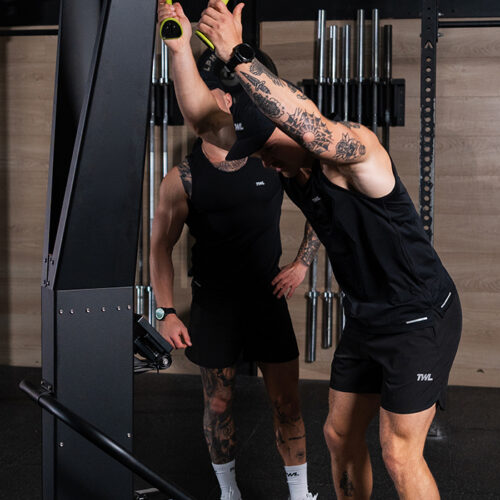


The 1,000m row sits right in the middle of a Hyrox race, and it is one of the most misunderstood stations on the floor. It looks like a chance to catch your breath, but row it wrong and you will either waste 30 seconds you did not need to, or blow your legs to bits before the next run. The good news is that rowing rewards a few simple decisions: the right damper setting, a sustainable stroke rate and a pacing plan. Get those three right and the row becomes a station you control rather than one that controls you.
Damper setting: forget the myth of 10
The damper is the lever on the side of the fan that changes how much air the flywheel pulls in. It does not set the resistance in the way most people think — it changes the feel of each stroke, not your score. Cranking it to 10 makes every pull heavy and grinding, which torches your legs and grip long before you finish 1,000m.
For most Hyrox athletes a damper of 4 to 6 is the sweet spot. It gives a smooth, rhythmic stroke you can repeat without frying your legs, and it keeps the fan spinning between strokes so you are not restarting from a dead stop each time. Taller, more powerful athletes may sit at the higher end; lighter athletes often row faster at 4. Whatever you choose, it should feel like a strong run, not a max deadlift.
Stroke rate: power per stroke beats frantic pace
Stroke rate is how many strokes you take per minute, shown on the monitor as s/m. Beginners tend to flail at 34 or more, which feels fast but wastes energy because there is little power behind each pull. A more efficient window for the Hyrox row is roughly 24 to 28 strokes per minute, with a strong, complete drive on every stroke.
The secret is the sequence: legs, then back, then arms on the drive, and the exact reverse — arms, back, legs — on the recovery. Push hard through your legs first, because they are your biggest muscles, then swing the body and finish with the arms into your lower ribs. Let the recovery be slow and relaxed; that is your rest. A good ratio is roughly one count on the drive to two on the recovery. Long, powerful strokes at a controlled rate cover 1,000m faster and cheaper than short, panicky ones.
Pacing: protect the legs, split it smart
Your split — the /500m pace on the monitor — is the number to watch. The classic mistake is ripping the first 250m at a pace you cannot hold, spiking your heart rate and arriving at the next run with dead legs. Instead, settle into a target split you know you can sustain and hold it steady.
A smart plan is to start slightly conservative for the first 200m, settle into your goal split through the middle 600m, and only lift the pace over the last 150m if you have it. That controlled negative-split approach means you leave the rower breathing hard but with legs that can still run. Remember the whole point: there is a 1,000m run waiting for you the moment you stand up, so the fastest row is the one that costs your running legs the least.
Posture and breathing
Sit tall and keep your chest up rather than rounding over the handle, which shuts down your breathing and your power. Draw the handle to the bottom of your ribs, not your chest, and keep your wrists flat. Sync your breath to the stroke — exhale on the drive, inhale on the recovery — and hold that pattern even as your heart rate climbs. Rowing is one of the few stations where you can actively recover your breathing, so use smooth mechanics to bring your heart rate under control before the run.
On and off the machine
Small transitions add up. Strap your feet quickly but properly — a foot that slips mid-row is worse than the two seconds you saved. When you finish, do not sprint off the rower with a spiked heart rate; take one deep breath, set the handle down, and move into a strong controlled jog rather than a stumble. Practise getting on and off so it is second nature under fatigue.
Train it before race day
Rowing technique falls apart when you are tired, so train it tired. Do intervals of 500m to 1,000m off the back of a run so your body learns to row smoothly with a high heart rate. Experiment with damper settings and stroke rates in training to find your personal sweet spot, and log the split you can hold without wrecking the next run. Dial in your damper, hold a steady stroke rate and pace to protect your legs, and the Hyrox row turns from a guessing game into free time on the clock.