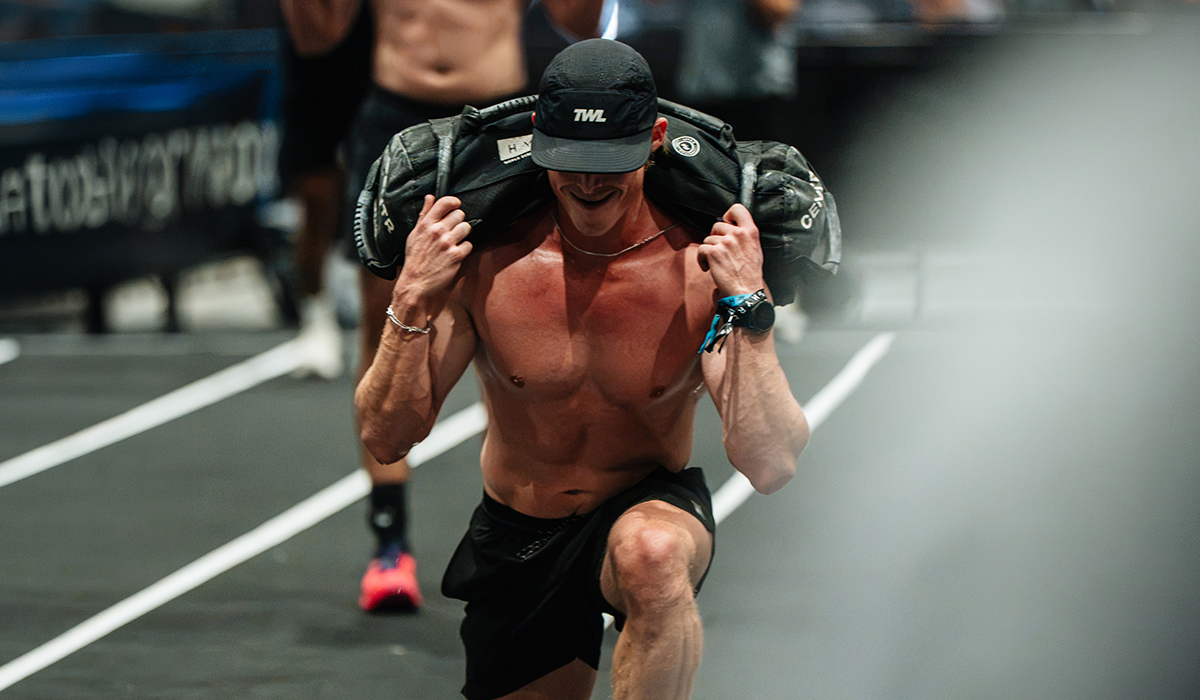

The Hyrox sandbag lunges are the last station before your final run, and they are where a lot of races quietly fall apart. One hundred metres of walking lunges with a sandbag on your shoulders, on legs that have already survived seven stations — it is brutal, and it is the point where good technique matters most. Lunge it well and you protect your legs for the finish; lunge it badly and you cook your quads with 1,000 metres still to run. Here is the technique, the leg-saving tips and the training that get you through.
What the Hyrox sandbag lunges actually involve
The station is 100 metres of forward walking lunges carrying a sandbag, usually racked across the back of your shoulders. Weights depend on your division — commonly around 20kg for men and 10kg for women in the open categories, and heavier in the pro divisions — so always check the current standard for your race. Each rep, your back knee must touch the floor and your front knee has to straighten as you stand, or the judges will send you back. It comes near the end of the race, so you arrive with fatigued legs and a high heart rate, which is exactly why pacing and form beat brute force here.
Sandbag lunges technique: save your legs
Rack the bag high and tight across your traps, not down your back, and squeeze it in place so it is not sliding around and stealing your balance. Stand tall through your torso with a braced core — the moment you round forward, the load pulls you down and your quads take all the strain.
Take a controlled step, drop the back knee to lightly tap the floor, then drive up through the whole front foot — mid-foot and heel, not just the toes. Keep your steps a comfortable, repeatable length; over-striding trashes your legs and under-striding wastes reps. Push up smoothly rather than bouncing, and let each rep flow into the next. Efficient, upright, rhythmic lunges cost far less than big, wobbly ones.
Pacing: steady beats stopping
The biggest mistake is attacking the lunges early, redlining your legs, then grinding to a halt. Standing still under a loaded sandbag barely lets your heart rate recover and every restart is expensive. A steady, unbroken 100 metres almost always beats fast-then-frozen.
Break it into chunks — four lots of 25 metres — and tick them off. Settle into a rhythm you honestly believe you can hold to the line, and only lift the pace over the last stretch if you have it. Remember the whole point: there is a 1,000-metre run the moment you drop the bag, so the fastest lunge is the one that leaves you able to run.
Breathing and the mental game
Pick a breathing pattern and stick to it — a breath as you step, a breath as you stand — so your heart rate stays controlled rather than spiralling. This station is a grind for everyone, so staying calm and mechanical while others stop is where you make up places. Keep your eyes up and focus on the next few metres, not the whole 100.
How to train sandbag lunges for race day
Train the exact movement under fatigue, because that is how it feels on the day. Add weighted walking lunges to your program with a sandbag at or above race weight, building your unbroken distance over the weeks. Practise 100-metre sets straight off a hard run or a rower so your legs learn to lunge with a screaming heart rate.
Back that up with general leg strength — squats, split squats and step-ups build the base that makes race weight feel lighter. Reverse lunges and Bulgarian split squats are great for single-leg strength and are kinder on the knees in training. And rehearse racking and unracking the bag so the transitions are smooth on race day.
Gear that helps your sandbag lunges
Training with a proper sandbag at race weight is the only way to truly prepare your shoulders, core and legs for this station. Flat, supportive cross-training shoes give you a stable base to drive out of each rep, and a pair of knee sleeves can add warmth and support for the knee that taps the floor. If you are gearing up for an event, the TWL Hyrox range has the essentials in one place — with Australian stock and fast AU shipping.
Hyrox sandbag lunges FAQ
How far are the Hyrox sandbag lunges? 100 metres of forward walking lunges, the final station before the last 1,000-metre run.
How heavy is the Hyrox lunge sandbag? It varies by division — commonly around 20kg for men and 10kg for women in the open categories, heavier in pro. Check the current standard for your race.
Do you have to touch your knee to the ground? Yes — each rep requires the back knee to make contact with the floor and the front leg to fully straighten, or it will not be counted.
Can you rest during the sandbag lunges? You can pause, but standing under the load barely recovers your heart rate, so steady, unbroken lunges are almost always faster.
The bottom line
Rack the bag high, stay tall and braced, and lunge at a steady, unbroken rhythm you can hold to the line. Train the movement under fatigue in the weeks before your race and the Hyrox sandbag lunges stop being the wall that ends your race and become the station you power through into a strong final run.