American vs Russian Kettlebell Swing: What’s the Difference?

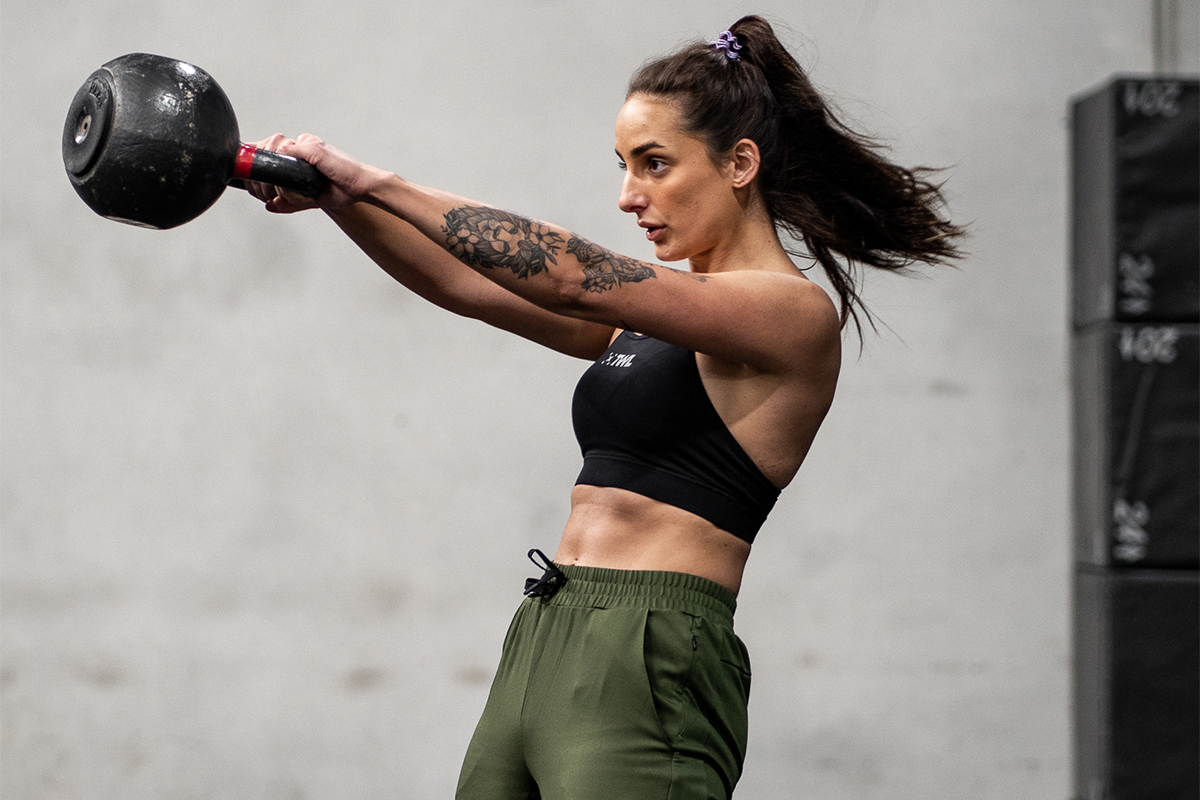
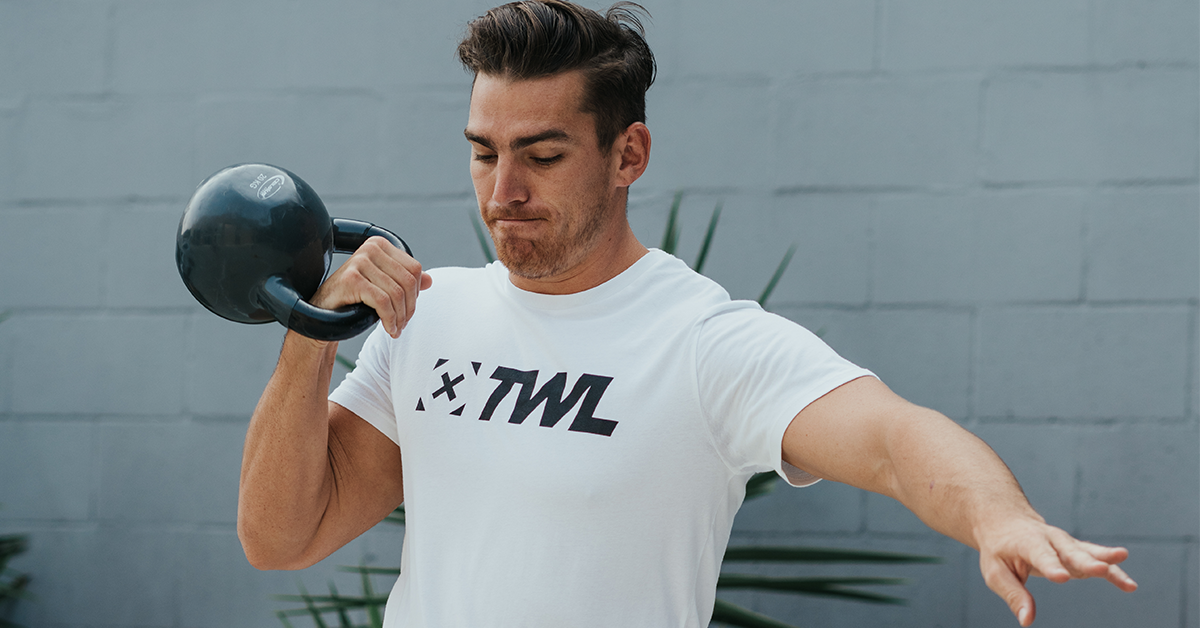
female athlete doing Russian kettlebell swing

Kettlebell exercises are a surefire go-to when you want to get your heart pumping, improve explosiveness, and build strength. But there are so many ways to use kettlebells — how do you know where to start? Well, let’s start with the standard swing itself. There are actually two ways to swing a kettlebell. This blog will go over the American vs Russian kettlebell swing, how they’re different, and the benefits of each.

American vs Russian Kettlebell Swing: What’s the Difference?

The only difference between the American vs Russian kettlebell swing is how high up you swing the kettlebell. In the American kettlebell swing, you finish the movement with the kettlebell overhead, pointing straight up to the sky. With a Russian kettlebell swing, the movement stops somewhere around chest height.

We’re borrowing this image from Set for Set. On the left, you see the Russian swing, with the kettlebell stopping around the chest/eyes. On the right is the American swing, with the kettlebell directly overhead.
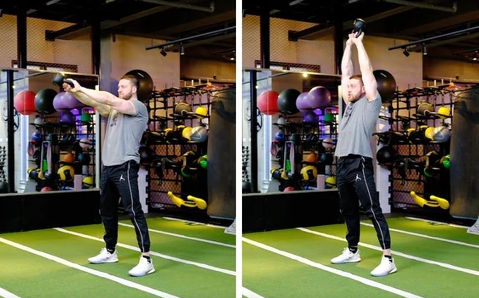
American vs Russian kettlebell swing

The mechanics are mostly the same when it comes to the American vs Russian kettlebell swing, but there are a few differences.

In the Russian swing, you have to engage your lats more. This is because you have to stop the kettlebell sooner so that you can reverse its direction. With the American swing, you need better shoulder mobility and stability since the kettlebell is traveling farther. For the same reason, you also need to use your hips and glutes more, in order to launch the kettlebell higher overhead. The American kettlebell swing is going to demand more explosiveness and power than the Russian kettlebell swing.

Shop Now

Is one kettlebell swing better than the other? In our opinion, not really. They’re just different! With the Russian kettlebell swing, you can lift heavier loads. So, it could lead to bigger strength gains. The American swing is going to give you more practice improving mobility, strength, and stability overhead, which is also important.

3 Important Reminders for Kettlebells Swings

Your best bet is going to be incorporating both American and Russian kettlebell swings into your programming. Here are a few helpful hints to remember:

1. Keep Your Back Straight and Core Engaged

If your back rounds and your shoulders sag, pause and collect yourself. Not only is this inefficient, but it also leaves your spine vulnerable and can lead to injury. Squeeze your abs and keep your spine aligned throughout the duration of the movement.

2. “Pop” the Kettlebell Up

The goal is not to muscle it up. It’s to “pop” it up! As you’re sending the kettlebell upward, use the force generated through your hips and butt to propel it to its apex. At the top of the swing, squeeze your glutes.

3. Relax Your Grip

Especially as you start to fatigue, you might find that you have a death grip on the kettlebell. Relax your hands! This will help you relax your forearms and shoulders, which means that you won’t fatigue as quickly.

Now that you know all about the American vs Russian kettlebell swing, which one will you tackle next? Let us know! And if you enjoyed this blog, you might like learning about banded kettlebell swings.
Kettlebell Squats: How to Do Them, Benefits, and Variations

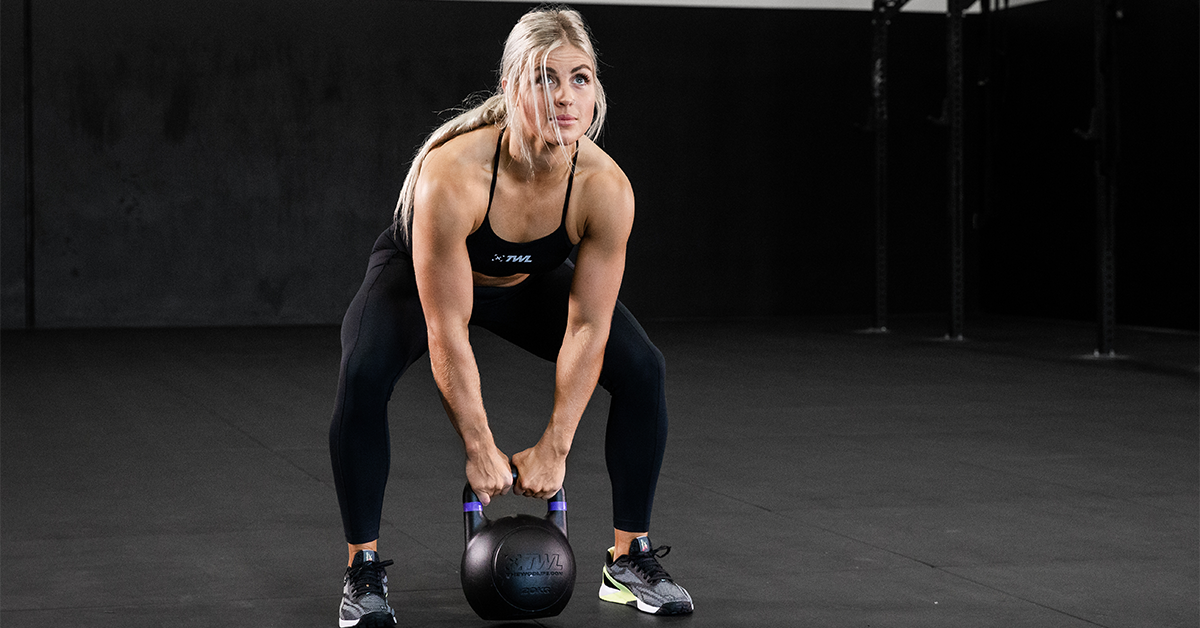
male athlete doing kettlebell squat

Maybe you need a break from the barbell. We feel you. But that doesn’t mean you have to hit the pause button on your squats. Kettlebell squats are a great squat variation. You can even use them as an additional accessory exercise to your regular programming. Let’s jump right in!

Wait, What is a Kettlebell Squat?

Let’s make sure we’re on the same page. When we talk about kettlebell squats, we’re actually referring to a group of exercises. The term reflects any squat that utilizes a kettlebell as opposed to a different piece of equipment.

“Kettlebell squat” can mean a number of different exercises. Let’s start there.

Shop Now

3 Types of Kettlebell Squats

While there are likely infinite ways you can hold a kettlebell and squat with it, here are a few popular variations you might want to try.

1. Kettlebell Goblet Squat

This might be the one you’re most used to. Here’s how you do this kettlebell squat:

  1. Position your feet approximately hip-width apart.
  2. Grip the sides of the kettlebell handle in your hands. It should be in front of your chest. Some athletes opt to hold the kettlebell upside down. Do what feels most comfortable for you.
  3. Perform a squat.

2. Kettlebell Sumo Squat

The kettlebell sumo squat is another go-to.

  1. Position your feet wider than shoulder-width.
  2. Bend your legs until you can grip the kettlebell with your hands.
  3. Stand up with the kettlebell. This is where you start the movement.
  4. Bend your legs until the KB touches the ground.
  5. Stand up. That’s one rep.

3. Front Rack Kettlebell Squat

You can perform this one with one or two kettlebells. The premise is the same! This mimics a barbell front squat.

  1. Place your feet hip-width apart.
  2. Lift the kettlebell to rest in the front rack position. If you’re using two kettlebells, you’ll have one on each side (like in the video below). You should be holding the handle in front of your shoulder. The KB should be resting on the outside of your forearm, with the elbow tucked in.
  3. Perform a squat.

These are just a few examples but as we said earlier, there are all sorts of kettlebell squat variations. For example:

  • Perform a front rack kettlebell squat into a press, to make a thruster!
  • With kettlebell goblet squats, you could add in a jump to up the intensity.
  • You can switch up the goblet squat and turn it into a pistol.
  • Hold one (or two!) kettlebells overhead for a challenging overhead squat.

Do Kettlebell Squats Build Muscle?

This one is probably obvious: Yes! The kettlebell squat muscles worked will depend on the specific type of squat you’re doing.

Any way you cut it, you’re performing a squat. So, you’re giving your quads, calves, hamstrings, glutes, and hips a serious workout.

Your upper body might also be playing a huge role. For example, to maintain the right position for a kettlebell goblet squat, you need to seriously engage your core. Otherwise, the KB will take you down.

On the other hand, because of the deadlift-esque positioning of the kettlebell sumo squat, you might feel an extra burn in your posterior chain specifically.

But… Are Kettlebell Squats Harder?

This is a tough question to answer because there are always ways to make any movement more challenging.

Instead, let’s look at it as kettlebell squats vs barbell squats. Are KB squats harder than barbell squats? If you’ve never done them before, then certainly. But that’s the case with any new movement. Rather, look at them as simply a different stimulus.

Training with kettlebells adds a layer of difficulty because whereas a barbell rests on your body, KBs can demand more control to hold and stabilize. Try doing an overhead squat first with a barbell and then with two kettlebells of the same weight (when combined). You’ll very likely find the kettlebell overhead squats more challenging.

This is especially going to be the case if you’re performing a unilateral exercise, meaning that you’re working one side of the body at a time. This is the case with one-arm front rack kettlebell squats or overhead squats. This type of exercise will be excellent for finding imbalances and weaknesses on one side of the body. (It’s important to balance these out! When one side of the body is significantly stronger than the other, it does more of the work. Down the line, this can lead to injury.)

3 More Kettlebell Squat Benefits

Aside from the specific muscles that KB squats target, what other benefits will you notice?

1. Better Core Strength and Stability

You need your core for everything — inside and outside of the gym. Squatting with kettlebells will help here, even though you’re not specifically targeting your core. In particular, certain KB squats — especially unilateral ones — are multiplanar. This means that you’re working your core from all directions.

2. Improved Balance

When working with a KB, you control the path it takes (unlike training using a machine and sometimes, even a barbell). As a result of needing to have more control over it, staying firmly and evenly planted between both feet will automatically be improved.

3. More Body Awareness

Training with a barbell tends to be more linear and less dynamic. Because a kettlebell is a smaller piece of equipment that you have to physically hold in your hands, you’re forced to pay more attention to your positioning and technique.

You now know how to do a kettlebell squat (several of them, actually!), you know the difference between kettlebell squats vs barbell squats, and you’re familiar with the benefits and muscles worked. Ready to get started? Awesome! Shop our selection of kettlebells today, and get to work!

How to Do the Kettlebell Sumo Squat

female athlete doing kettlebell sumo squats

We’ve talked before about how much we love kettlebell exercises. The kettlebell is endlessly versatile and allows for a full-body workout. If you want to sweat up a serious burn, try the kettlebell sumo squat.

In this blog, we’ll break down what it is, how to do it, and what the benefits of kettlebell sumo squats are.

What is a Kettlebell Sumo Squat?

When we’re talking about anything “sumo,” in a nutshell, that means that your feet are positioned wider than they normally would be.

For instance, in a traditional deadlift, your feet are slightly inside your grip. In a sumo deadlift, your feet are outside of your grip, which is narrower than normal.

It’s the same for a kettlebell sumo squat. Whereas your feet would normally be hip-width apart (for a squat), you move them apart more than this, with your toes slightly pointed out.

This exercise is technically a combination of a squat and deadlift. Let’s break it down.

Shop Now

How to Do It

Here’s how to execute a kettlebell sumo squat step by step:

  1. Position your feet outside the width of your shoulders. Point your toes outward slightly.
  2. Bend only at the hips and knees until your hands meet the kettlebell.
  3. Grip the kettlebell handle with both hands.
  4. Extend your hips and knees to stand. This is your starting position.
  5. Bend at the hips and knees until the kettlebell touches the floor.
  6. Return to standing. This completes one rep.

Note that your arms should stay straight throughout the exercise. Keep your neck neutral by looking forward (and maybe slightly down — see what feels most comfortable). Check it out!

We mentioned that this is a combination of a squat and deadlift. It’s like a squat because you’re bending the lower half. It’s like a deadlift because you’re picking weight up and setting it down. But unlike a deadlift, you should not be hingeing at the hips! In other words, your torso doesn’t move all that much.

Kettlebell Sumo Squat Benefits

Performing sumo squats with a kettlebell offers a number of benefits. Kettlebell sumo squat benefits include targeting your:

  • Glutes
  • Quads
  • Adductors
  • Hamstrings
  • Gastrocnemius (which makes up most of your calf muscle)
  • Soleus (which lays under your gastrocnemius)

And if you suspected that the exercise also works your core, you are correct! You can’t maintain the proper upright position, alignment, and stability without engaging your core muscles.

The Kettlebell Sumo Squat vs Goblet Squat

Because both movements involve a kettlebell and the word “squat,” athletes sometimes think that they’re interchangeable. However, the two movements are quite different.

In a kettlebell goblet squat, you have a traditional, hip-width stance. Also, you’re holding the kettlebell against your chest with both hands, and that’s where it stays. It looks more like a typical squat, with no deadlifting characteristics involved in the movement.

Will you start training sumo squats with a kettlebell? Begin with a modest weight so that you can first become familiar with the movement and how to perform it safely. Always remember to stay in control, and never sacrifice technique and form for heavier weights or more reps.

Shop The WOD Life’s selection of kettlebells today.

The Single-Leg Kettlebell RDL

We’ve talked before about the importance of doing unilateral exercises. They help you find muscle imbalances, target weak spots, and focus more specifically on certain areas.

And here’s the cool part. You don’t need a ton of weight to make a difference. Grab a moderate kettlebell (or dumbbell) and try the single-leg RDL. Here’s a demo from Brooke Ence.

https://www.instagram.com/p/CCT8QtHHCOc/

It’s slow and low-impact, but don’t be fooled. You’re going to feel the burn on this one. Focus on form and the quality of movement, and really work to keep your hips squared.

The single-leg RDL is an excellent accessory exercise to add into your programming. Give it a shot!

Main image: Brooke Ence/Instagram

Try This KB Exercise From Chyna Cho to Work on Core Stability

Chyna Cho is the champ of accessory work. She recently shared one exercise that’s awesome to work on your core strength and stability: kettlebell overhead squats. Check ’em out.

View this post on Instagram

A post shared by Chyna Cho (@chynacho) on

Working with kettlebells is so different from training with a barbell because you have to stabilize the equipment from side to side — not just forward and back. Thus, it requires a lot more control on your part. Holding a kettlebell overhead for squats is a total-body workout. Start with a lighter weight to first get comfortable with the movement.

Main image: Chyna Cho/Instagram