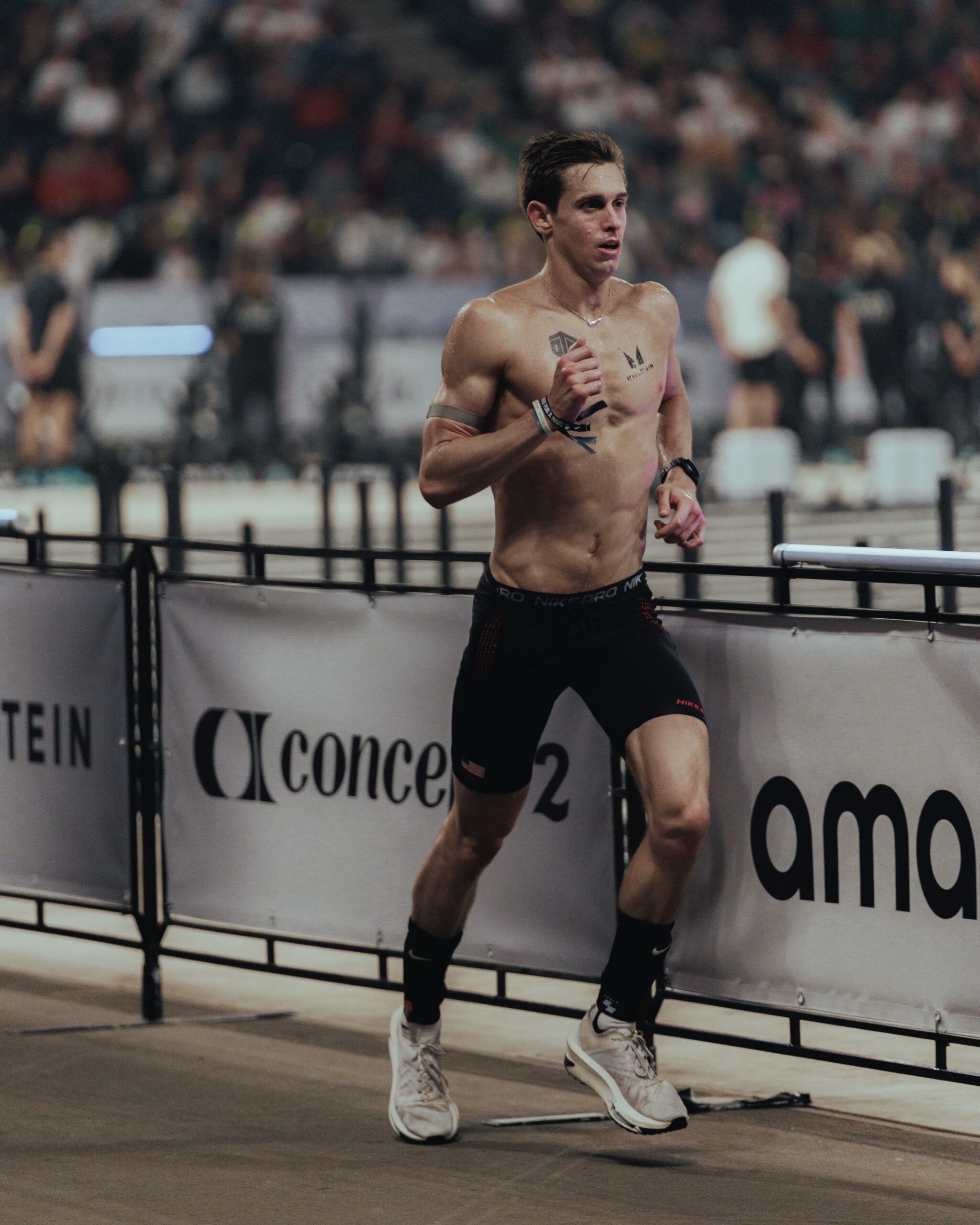
Calm, Collected, Champion: Inside Dylan Scott’s First HYROX World Title
Written by TWL Editor in Training,
 25 min read
There’s a certain kind of athlete who makes the hardest thing in the room look almost boring. No wild-eyed intensity, no theatrics on the start line — just a quiet confidence that they’ve done the work and they know exactly how the next 55 minutes are going to unfold. That was Dylan Scott in Stockholm. And at his sixth HYROX World Championships, the calm finally paid off in the biggest way possible: a first individual world title.
The way the South Carolina athlete got there — a mid-race deficit, a six-deep chase on the last station, an ice-cold finish — is one of the best come-from-behind wins the sport has produced. But the more interesting story is the decade of grit that built the man who pulled it off. It’s also a timely reminder of just how far HYROX has come, including here in Australia, where the sport has become one of our fastest-growing fitness obsessions.
The race: a champion made on the last station
Scott didn’t lead this race. Not early, not in the middle, and not even walking into the final station. Previous champions Tim Wenisch, Hunter McIntyre and Alexander Rončević surged to the front from the gun and stayed there.
Here’s the thing, though: Scott expected it, and it didn’t rattle him.
“I’ve been behind a lot of times and worked my way back into races before,” he told Morning Chalk Up. “This is 55 minutes long. If I’m behind by a minute at minute 22, well, the first 22 minutes aren’t really my forte anyway. I still have 33 minutes to reverse this.”
That’s the mindset of a veteran who knows his own engine. Scott’s weapons come later — the burpee broad jumps (“I’m a savage at burpees. I will track you down”), and the run-row-run section where he methodically reels competitors back in.
By the time the field hit the wall balls — HYROX’s brutal 100-rep finishing station — Scott was sixth into the pen. On paper, he was racing for fourth. Then the race turned. Backing himself to hit 100 unbroken as always, he started climbing: past Charlie Botterill, level with a penalised Louie Osselaer, McIntyre drifting back into range. Out front, leader Wenisch began to crack, breaking his set roughly every seven reps.
“He breaks at 95,” Scott recalled. “I’m like, ‘as long as I can do these and get one step on him, I’m gonna outrun him.’ So I throw the last one, see it tag the target, see the little green, and I’m already going.”
He out-sprinted the leader off the final wall ball to snatch the title. Sixth into the last station, first across the line.
From Ninety Six to the world stage
To understand that composure, you have to go back to Ninety Six, South Carolina — a town of around 2,000 people and a Revolutionary War battleground where Scott did much of his early training. The high school track had five and a half lanes, “because you got to the back and half of it fell off a hill.” The weights were rusty. Some of his conditioning was done dragging tractor chains around the yard.
“It wasn’t this pretty thing you get with HYROX, this production,” he told Nike. “It was grit… I came from doing workouts with tractor chains in the yard to standing on podiums at World Championships.”
It nearly never happened. Right before he turned 18, a freak injury on a treadmill — watching, of all things, the Steve Prefontaine movie — left his right foot “completely dead” within 15 minutes. He spent his senior year on crutches, in a cast, at points in a wheelchair, and the elite-runner future he’d built his whole identity around evaporated.
“My sense of purpose was stripped away,” he said. “I had to sit down and ask: ‘Who am I? What else is going to occupy this space?'” The recovery took four or five years. Looking back, he calls it something he’s thankful for — it reshaped who he was. He found HYROX almost by accident in 2021, has raced every World Championships since, and climbed the podium a little higher each year, taking third in Chicago the season before finally topping it in Stockholm.
The mindset: choosing hell
If there’s one line every weekend warrior should tattoo on their water bottle, it’s this. Scott knows the exact moment a hard session tips into suffering, and he chooses it anyway.
“When I’m at the 45-minute point of a workout, knowing that at 55 we’re going to enter that spot, I think: this is going to be hell. But today I’m choosing hell, because I still want to be a world champion.”
He’s equally clear that grit has a limit. “A lot of athletes in HYROX really value the ability to suffer and sometimes test it too much… you just burn your body out.” His north star is effort over outcome: “Outcomes take care of themselves when you put enough into them.” It’s a healthier, more sustainable way to think about training than chasing the pain for its own sake — and it’s a big part of why he’s still climbing after six years.
The Nike deal — and winning the right way
In January, Scott signed with Nike, a dream he’d “almost let die” after his running career ended. Performance testing at the brand’s LeBron James Innovation Center in Portland gave him data on his own body he could never have gathered dragging chains in the yard.
But he’s adamant about how he wants to win. “I’m not going to race dirty. I’m not going to trash-talk you publicly or try to belittle you… I want to be a champion where people say, ‘This guy did it the right way.'” He credits his wife, Maria, for pushing him to leave a secure corporate job for the sport, and says his son, August — who doesn’t care whether Dad’s on the podium, only that he shows up — keeps the whole thing in perspective.
What it signals for the sport — and for HYROX down under
HYROX has exploded on a beautifully simple formula: eight 1km runs, eight functional stations, the same format everywhere in the world. Australia has been one of its fastest-growing markets — sold-out events in Melbourne, Sydney and beyond, gyms building dedicated HYROX programming, and a flood of first-timers chasing that maiden finish line.
Champions like Scott, who talk about the sport being “a place for everyone,” pour fuel on that fire. Races selling out across Australia feel less like a fad and more like the sport putting down permanent roots — and every weekend warrior grinding through wall balls at their local box is now part of the same global movement that just crowned a world champion in Stockholm.
Chasing your own finish line
The best part of HYROX is that the barrier to entry is low: the format rewards consistent training far more than fancy kit. A few pieces do make it smoother, though — a stable running-and-lifting hybrid shoe, a set of grips for the wall balls and sled work, and a weight vest to build that race-specific engine at home.
We’ve pulled together our favourite HYROX-ready gear in the TWL HYROX collection. Dylan Scott spent a decade learning to stay calm, trust the work, and choose hell on the days it counts. The rest of us can borrow the mindset today.